Aureus-Quartett
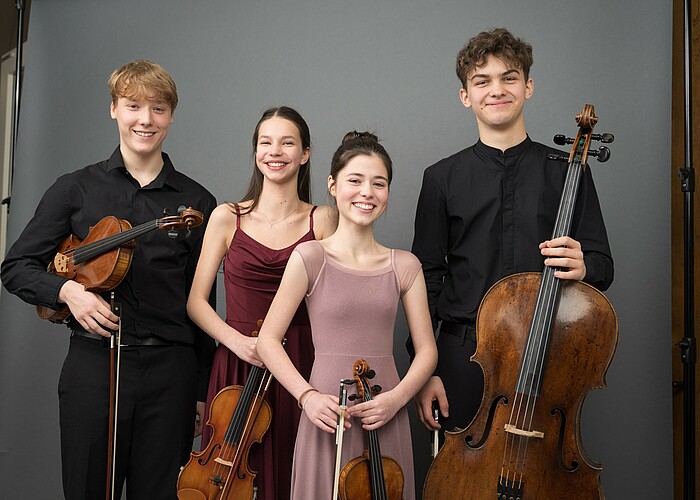
vlnr: Jakob Maximilian Rau, Shira Fuchs, Laila Honda, Lennard Noah Voigt
source: Aureus Quartett, Julis-Stern-Institut Foto: Peter AdamikPerformance of the first movement from Nikolai Kapustin’s String Quartet, Op. 88
In the context of the open call UdK x Berlin, the performance of the first movement of Nikolai Kapustin’s string quartet is understood as a situational negotiation between the university, the city, and the audience. The urban fabric is not treated as a mere backdrop but, through the Julius Stern Institute, as a resonant space – an arena of shared attention, historical responsibility, and contemporary artistic practice. In this sense, UdK Berlin is not represented in a classical way, but rather examined in dialogue with urban society and its multilayered history.
The Julius Stern Institute serves as both a concrete and symbolically charged point of departure. Its history – from the founding of the Stern Conservatory in 1850 and its acquisition as the sole property of Julius Stern in 1856, through its significance as a Jewish-influenced institution of European music education, to its expropriation through forced sale in 1936 and the murder of its then owners – is inseparably linked to the history of Berlin. The later integration of the remaining institution into the Hochschule der Künste Berlin, renamed the Berlin University of the Arts (UdK Berlin) in 2001, marks the continuation of this legacy. This history continues to resonate today – in the institute’s self-image as a place of the highest artistic quality, social openness, historical responsibility, and lived diversity.
Against this background, the project deliberately places Jewish and non-Jewish young, talented musicians of the Julius Stern Institute at its centre. The string quartet as a formation stands as an exemplar of the institute’s core values – community, mutual listening, and a high degree of individual responsibility within a collective artistic process. At the same time, this ensemble enables an immediate and transparent form of communication with the audience.
With the performance of the first movement of Nikolai Kapustin’s String Quartet, Op. 88, a work is chosen that makes productive polyphony audible. Kapustin’s fusion of classical form with a jazz-based idiom – developed under conditions of cultural and spatial separation – demonstrates how diversity functions as a creative force: self-evident, progressive, and connecting across boundaries.
Biographies
The Aureus Quartet was founded in October 2025 at the Julius Stern Institute of the Berlin University of the Arts. The ensemble consists of the 14-year-old Shira Fuchs (first violin), the 13-year-old Laila Honda (second violin), the 16-year-old Jakob Maximilian Rau (viola), and the 16-year-old Lennard Noah Voigt (cello).
All four musicians combine intensive solo training with an early and sustained passion for chamber music. Shortly after its founding, the quartet appeared successfully in its first public concerts, impressing audiences with a high level of shared musical interpretation.
The Aureus Quartet is coached by the Leonkoro Quartet and additionally supported by the Julius Stern Institute. Alongside their quartet work, the members are gaining extensive experience as soloists, orchestral musicians and chamber musicians in renowned youth ensembles. All four musicians are prizewinners of national and international competitions. Shira Fuchs recently participated in the Perlman Program for Outstanding Musicians; Laila Honda, Jakob Rau and Lennard Voigt are scholarship holders of the German Music Life Foundation (Deutsche Stiftung Musikleben).
In March, the Aureus Quartet will perform at the Julius Stern Institute’s major benefit concert in support of children suffering from rheumatic diseases. In April 2026, the quartet will present one of the renowned lunchtime concerts at the Berlin Philharmonie.