crescendo26: GegenTöne - Counter-Tones
Auf[er]stehen! (Arise!) Final concert Conducting with the Brandenburg State Orchestra Frankfurt – crescendo
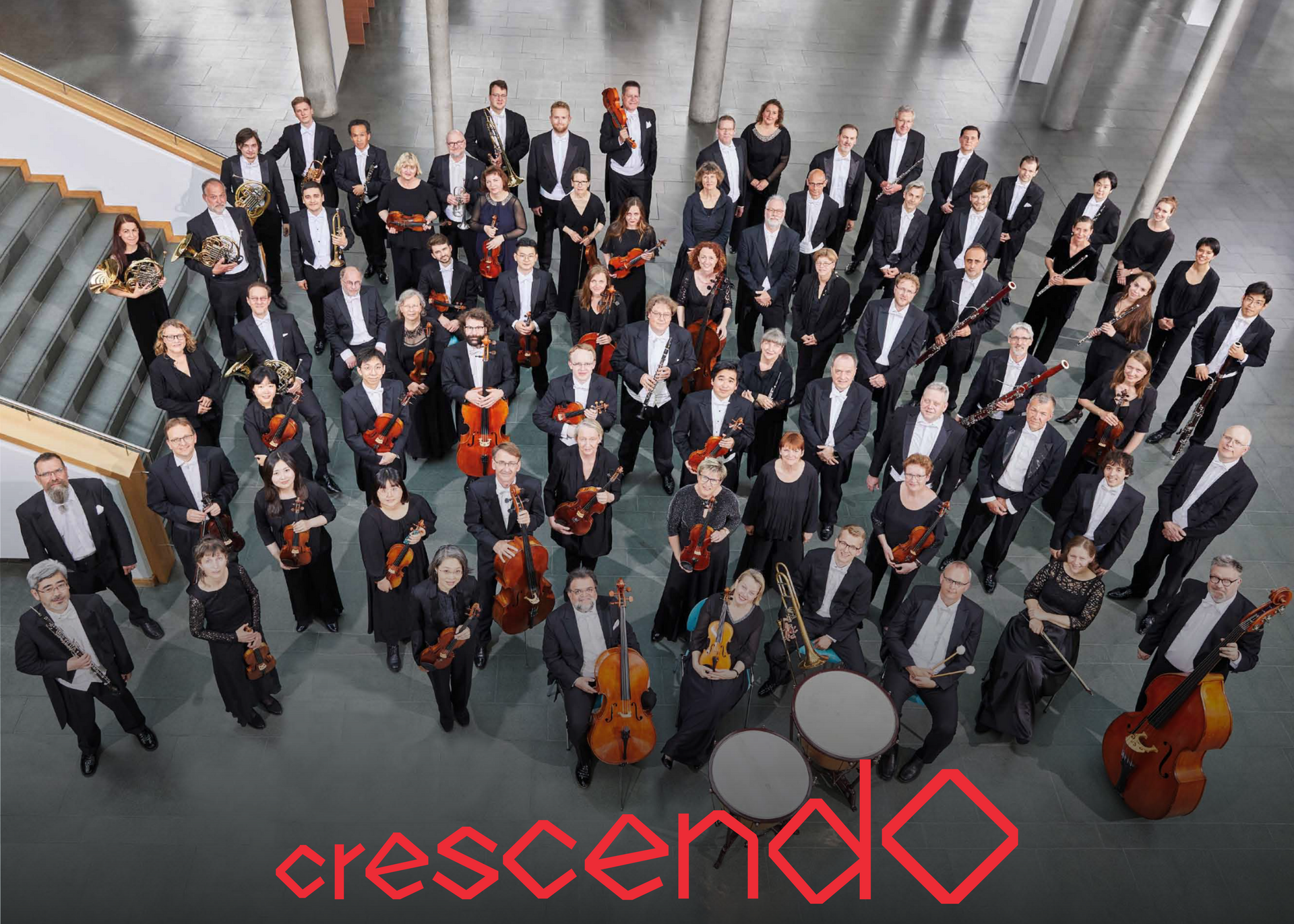
Three conducting students from the Berlin University of the Arts will conduct their final concert this evening – the Brandenburg State Orchestra Frankfurt will follow their baton.
Gustav Mahler: Funeral Rite – Symphonic Poem (1888) for orchestra
Elsa Barraine: Symphony No. 2 | Samuel Barber: Adagio for Strings
Johannes Brahms: Symphony No. 3 in F major, Op. 90
Brandenburg State Orchestra Frankfurt / Konstantinos Angelidis, Judith Baubérot, Kentaro Machida, conductors
French composer Elsa Barraine, winner of the Prix de Rome, was no stranger to rebelling against entrenched structures and regimes. Her Second Symphony, composed in 1938, powerfully conveys the feeling of impending war, in which Barraine herself would become a target as an artist, communist and Jew. In 1941, she co-founded the Front National des Musiciens, the resistance movement of French musicians, and remained politically active until her death in 1999: in the best sense of a counterpoint.
A counterpoint is a contrasting voice to a melody. Johannes Brahms made frequent use of this technique, which was particularly common in the Baroque period, in the 19th century, transferring it to the large symphony orchestra: a purely musical counterpoint!
Gustav Mahler himself formulated thoughts on the symphonic poem Totenfeier (Funeral Rites), which vividly transport us into a tragic counterworld: “At the grave of a loved one. His struggles, his suffering and his desires pass before the mind’s eye. Questions arise: What does death mean – is there continuity?” Is there resurrection after death? The composer succeeded impressively in expressing these feelings of “here” and “there” in music in his immediate musical language.
Support us!
The Berlin Senate has imposed enormous savings targets on public universities. You know that: An excellent musical education consists not only of the many hours of solitary practising and lessons by professors, but also, to a large extent, of performing in front of an audience. This inherent part of the training is also the opportunity for you to attend almost always free concerts at a high level. We don't want to have to cut back on this. By attending our events, you can also show those responsible in politics that music and art are meaningful for every society. And if you can: support us with small or large donations. The donations are used for teaching, tuning, transport, advertising material, for our music festival crescendo - wherever no funds can be spent at the moment. This directly benefits our students and also you as the audience, as this is the only way we can maintain events of this calibre and variety.
Thank you very much!
Info
crescendo – Künstlerisches Betriebsbüro der Fakultät Musik
crescendo@udk-berlin.de