Künstlerisch-gestalterisches Weiterqualifizierungsvorhaben
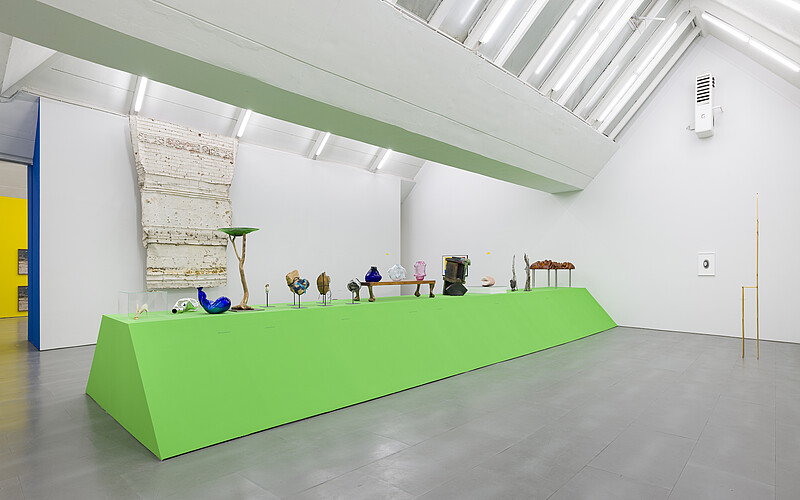
01 Good, T. (2022). Standing, Exhibition at Carlier | Gebauer Berlin Gallery, Exhibition View [Photograph]. Travor Good.
source: Trevor Good
The Archive of Thoughts at Dopo?, Fuori Salone, Milan Design Week 2023, Exhibition View [Photograph]. Louis De Belle.
source: Louis De Belle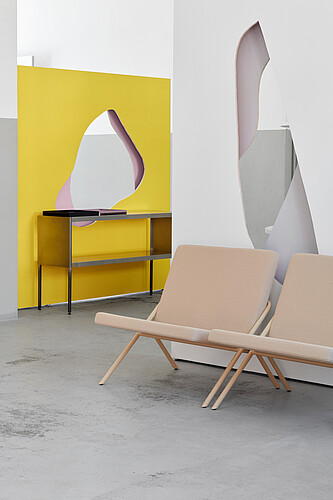
Lux, E. Z. (2024). Satellite placed in urban environment
source: Enzo Zak Lux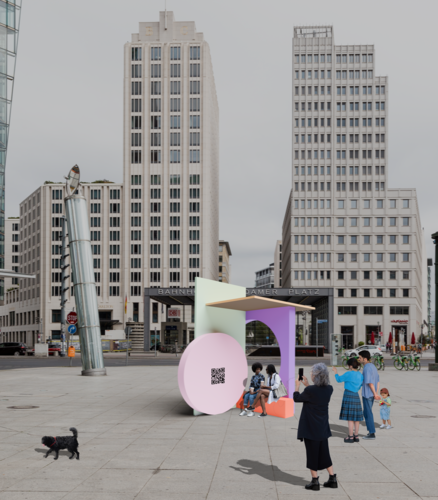
04 Lux, E. Z. (2024). Mixed Reality Exhibition Experience
source: Enzo Zak Lux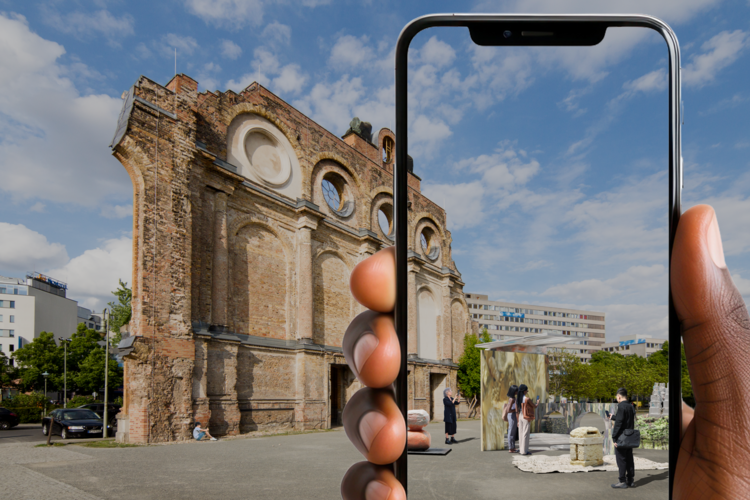
Lux, E. Z. (2024). Images of Process, Digital Exhibition Building in Rhino [depicted Artworks „Future Ruins. Five Monuments for a Human Planet“ by Jannis Zell, Kalrsruhe 2019]
source: Enzo Zak Lux.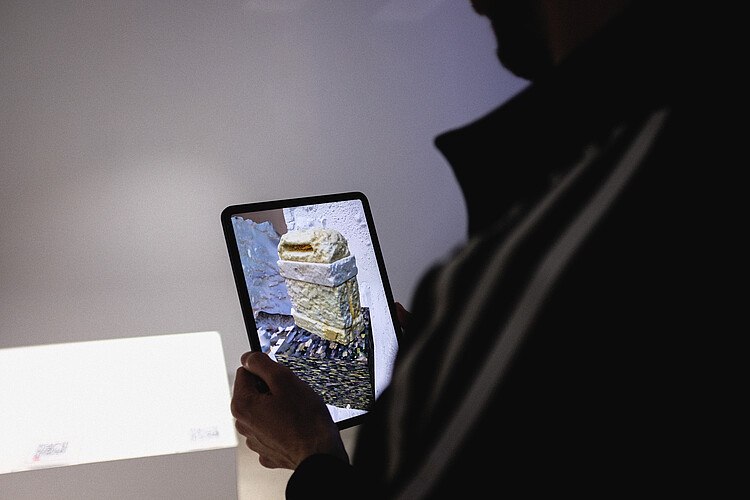
Lux, E. Z. (2024). Photo Documentation of Mixed Reality Exhibition. Implemented in V1 Gallery, Aalto University [depicted Artworks „Future Ruins. Five Monuments for a Human Planet“ by Jannis Zell, Kalrsruhe 2019]
source: Enzo Zak LuxGrowing inequality in wealth and income, questions of identity and changing social norms, as well as the increasing importance of digital information technologies, are among the greatest challenges of our time. Museums are not left untouched by these challenges. Firstly, the discourses mentioned above are reflected in socially collaborative works. Furthermore, they are forcing museums to critically examine their institutional past and to reposition themselves. In recent years, alongside the collection, preservation and exhibition of cultural artefacts, the promotion of cultural and social exchange, as well as a diverse programme of outreach activities, have become part of the remit of a modern institution. Museums are transforming from temples of art preservation, which exude an institutionalised hierarchy, into cultural centres aiming to appeal to broad audiences. In this process of development, digital technologies are becoming an increasingly important tool. Consequently, the museum’s outreach to its audience is increasingly extending from the physical into the digital realm. Today, museums reach hundreds of thousands of young people worldwide via their own websites and social media channels. The experience of art, art education and community building is becoming increasingly digital and thus less location-dependent. Although this is not an entirely new trend, it has received an enormous additional boost in recent years, particularly due to the months-long closures during the Covid-19 pandemic. In this context, Instagram has now become the preferred social media platform for museums. When it comes to the question of how museums might evolve in the future, the prediction of decentralisation crops up time and again. Some renowned museum architects envisage that, in future, museums might appear not only in their main buildings but also in the form of satellite venues scattered throughout the city. Given the ongoing digitalisation of art education and the predicted decentralisation, it therefore seems only logical that the way in which artefacts are exhibited and experienced will change accordingly. Even though fully immersive exhibition experiences are currently very popular, and exhibitions such as ‘Imagine Van Gogh: The Immersive Exhibition’ are popping up worldwide in locations that were originally not designed as exhibition spaces, it is reasonable to assume that, whilst the exhibition experience may become more digital in future, it will not completely replace a visit to a museum or the artefacts on display.
From the perspective of an exhibition designer, my ongoing qualification project examines how the experience of artefacts in a physical exhibition space will change as digitalisation progresses. What proposals can scenography offer to actually enhance the significance of the physical experience of artefacts by extending the exhibition experience into the digital space? How could interactions between the analogue and digital spaces be implemented in exhibition architecture, and what form might these take? To find answers to these questions, I am approaching the physical exhibition space from various perspectives and exploring methodologies for conveying information using digital and analogue technologies. My research focuses on two central questions: Which digital technologies for the virtual representation of objects and spatial experiences will be relevant to the discipline of exhibition design in the long term? What trends can be identified based on an analysis of existing exhibition concepts from previous years?