Orchester & Dirigent
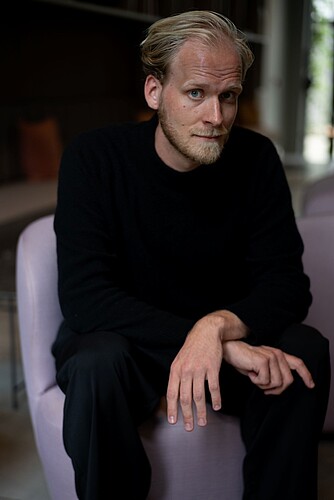
Christian Øland
With his powerful and clear musical language, Christian Øland is one of the most sought-after Scandinavian conductors of the younger generation. He moves with great ease between different styles, genres and eras: from Haydn and Beethoven through Mahler, Strauss and Bruckner, Nordic classics such as Nielsen and Sibelius, 20th-century works by Poulenc and Martinů, right through to world premieres of new compositions.
As Chief Conductor of the Danish Philharmonic Orchestra and General Music Director of the Magdeburg Philharmonic and the Magdeburg Theatre, Christian Øland took up two new leading positions in the 2025/26 season. With the Magdeburg Philharmonic, he will conduct Jules Massenet’s Manon Lescaut for the first time, as well as the ballet evening Drifting Out with choreography by Iratxe Ansa, Igor Bacovich and Yaron Shamir. Major debuts and return engagements will see him take the podium with the Danish National Symphony Orchestra, the Royal Danish Orchestra, the Oslo Philharmonic, the Copenhagen Philharmonic and the Gothenburg Symphony Orchestra.
Christian Øland enjoyed early success as a conductor of dance and musical theatre productions. In the 2024/25 season, he took on the musical direction of a production of Poul Schierbeck’s opera Fête Galante at the Danish National Opera. In 2023, he conducted the Copenhagen Philharmonic Orchestra at the Royal Danish Playhouse in the world premiere of Leaning Tree. Other notable productions included Mats Ek’s highly acclaimed choreography Julia and Romeo with the Royal Swedish Ballet, Tchaikovsky’s The Nutcracker with the Royal Danish Ballet, and The World of John Neumeier with the Hamburg Ballet.
Christian Øland was born in 1994 and studied piano and bassoon. At the age of 18, he was accepted into the conducting class at the Sibelius Academy in Helsinki, where his teachers and mentors included Atso Almila, Hannu Lintu, Leif Segerstam, Jorma Panula, Herbert Blomstedt and Esa-Pekka Salonen. Just one year later, he became Hannu Lintu’s assistant at the Finnish Radio Symphony Orchestra, where he soon began conducting his own concerts. This was followed by invitations to conduct leading Nordic orchestras.
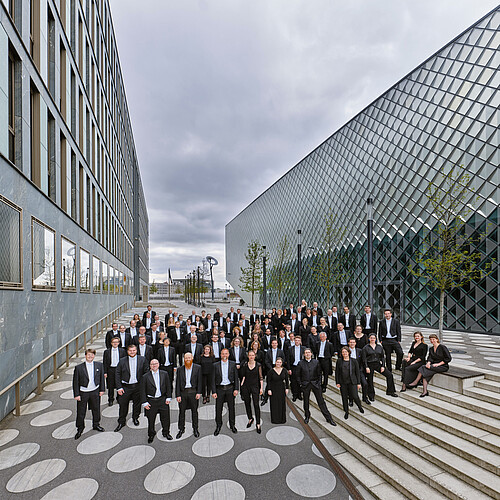
Rundfunk-Sinfonieorchester Berlin
For over 100 years, the Berlin Radio Symphony Orchestra (RSB) has been an integral part of the German music scene. Founded on October 29, 1923, it is one of the oldest radio orchestras in Europe and reflects 20th-century German history. Influential conductors such as Eugen Jochum, Sergiu Celibidache, Kurt Weill, and Paul Hindemith, as well as later principal conductors such as Marek Janowski (2001–2016) and, since 2017, Vladimir Jurowski, have shaped its unique sound.
In the 2026–27 season, Jörg Widmann will take center stage as Artist in Residence, presenting symphonic and chamber concerts as well as a master class. International guest conductors such as Andris Nelsons, Yannick Nézet-Séguin, and Lahav Shani have made their debuts with the RSB, while young talents like Tarmo Peltokoski and Petr Popelka are shaping the orchestra’s artistic direction.
A key focus is on contemporary music, particularly works by female composers such as Unsuk Chin, Kaija Saariaho, and Anna Thorvaldsdóttir, complemented by artists such as Max Richter and Tan Dun. The RSB performs worldwide and will present 25 symphony concerts at the Philharmonie and the Konzerthaus Berlin during the 2026/2027 season. In addition, there are chamber music concerts, jazz and family concerts, as well as series such as “Concerts for Everyone” and “Rapauke” for children.
Almost all concerts are broadcast on the radio. In 2025, there were 86 concert broadcasts in 26 countries. The RSB also produces studio recordings of lesser-known works, most recently symphonies by Paul Büttner and piano concertos.
Michael Cohen-Weissert
Composer Commissioned Work
Michael Cohen-Weissert is a composer, pianist, and conductor. His work moves between performance and composition across different genres, including jazz, folk, and contemporary classical music. He is also active as a jazz pianist and is continually seeking ways to develop into a more universal musician. Born in Jerusalem in 1993, he moved to Berlin in 2008, where he has since established himself and is currently based. He has a diverse career, performing as a soloist and conductor with orchestras such as the Israel Philharmonic Orchestra, the Jerusalem Symphony Orchestra, the Haydn Orchestra of Bolzano, and the Norddeutsche Philharmonie Rostock, as well as appearing as a sought-after chamber musician alongside artists such as Claudio Bohórquez, Jens-Peter Maintz, Máté Szücs, Mark Bouchkov, and Nur Ben-Shalom, among others. As a composer and arranger, he collaborates closely with numerous musicians and projects, including the project Lebensmelodien, for which he has composed and arranged over forty pieces inspired by melodies written between 1933 and 1945. His music is regularly performed by musicians and ensembles such as Philharmonix, Tomoki Park, Markus Merkel, and the Nimrod Ensemble. In 2018, his first opera, AMALIA!, was premiered in Bolzano. Believing that a modern artist must not only perform but also help shape artistic contexts, he founded the Charles Rosen Ensemble, dedicated to the performance and promotion of contemporary music, and serves as co-artistic director of the festival Éole en Musiques in France. He recently founded the Junction Ensemble, a multi-genre group that brings together musicians from different backgrounds with the aim of exploring connections between styles and traditions. His piano teachers were Elena Lapitskaja, Jacques Rouvier, and Stefan Arnold. He also attended composition classes with Elena Mendoza and Marc Sabat, as well as chamber music classes with teachers such as the Artemis Quartet and Eberhard Felz. In addition to his studies, he attended masterclasses and worked with musicians including Claude Frank, Bruno Rigutto, Aldo Ciccolini, Paul Badura-Skoda, and Peter Serkin.