Engelbert Humperdinck
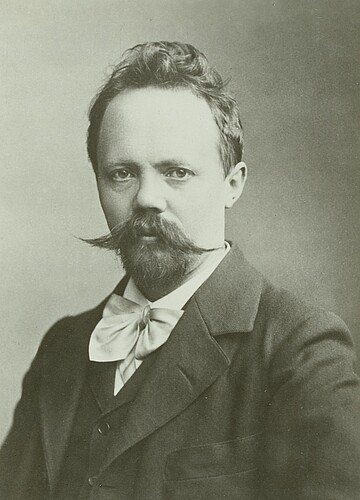
Engelbert Humperdinck, the composer of the opera “Hansel and Gretel,” was one of the early faculty members at the Berlin University of Music, now the Music Faculty of the UdK. His hometown of Siegburg is now organizing a symposium on his teaching career and his students: “Humperdinck—The Teacher and His Students” (November 6–7, 2026). He certainly deserves a mention in this column on the history of higher education!
At the turn of the year 1900–01, Engelbert Humperdinck left his rural idyll in Boppard on the Rhine, where he had settled, for Berlin, the imperial capital and metropolis. The reason for this move was an offer personally delivered to him by a representative of the Prussian Ministry of Culture: the position of “director” of a “Master School for Musical Composition” at the Royal Academy of Arts. The terms were favorable: the position was prestigious, well-paid, and, with moderate responsibilities, allowed Humperdinck sufficient leeway to continue his own compositional work.
Humperdinck gave up his refuge in the western part of the German Empire and entered Prussian civil service. By decree dated November 5, 1900, the Prussian Minister of Ecclesiastical, Educational, and Medical Affairs announced the appointment. At a meeting of the Senate of the Academy of Arts on January 4, 1901, Humperdinck was inaugurated into his office. The appointment was made “in the confidence” that, as a composition teacher, he “would remain devoted to His Majesty the King and the Most High Royal House with unwavering loyalty […].”
With his appointment, Prussian art policy followed the judgment of the art-loving public. Following the spectacular success of the opera *Hansel and Gretel* (1893), Humperdinck was at the height of his fame. His appointment indicates that those in charge of Prussian arts policy—not least the official in charge of art and music, Friedrich Schmidt-Ott—were no longer content to limit such appointments to the various offshoots of a “Berlin School” or to local connections.
Humperdinck’s connection to Berlin, which was now established, had a history: Although the young Humperdinck had not studied here, he nevertheless came into contact with the University of Music. Born in Siegburg and thus hailing from the Prussian Rhine Province, he was eligible to apply for a scholarship from the Meyerbeer Foundation and for the Mendelssohn Foundation Prize, both of which were awarded from Berlin. Humperdinck was successful in both cases, in 1879 and 1881. The manuscripts of the compositions he submitted are still housed at the UdK today, in the care of the University Library. They are the “dramatic cantata” Die Fischerin for soloists and orchestra and the Humoresque in E major.
The Mendelssohn Prize was awarded by a three-member board of trustees headed by Joseph Joachim. The prize money enabled Humperdinck to spend time in Italy, which contributed to his joining the ranks of the “New Germans.” That was certainly not the intention of those who had made his trip possible.
But that was long past by the time he arrived in Berlin at the turn of the century. As a follower of Wagner, he was now hardly controversial; the musical poet of the German fairy tale did not cause offense. He also seems to have been conciliatory when it came to settling the financial aspects of his teaching position: “Hümpchen” let himself be led around “as if in a dream” and “forgot” to conduct appointment negotiations, Cosima Wagner wrote in a private letter. This is consistent with how a student of his, the pianist and writer Walter Niemann, characterized him: Humperdinck was “always a little pensive, dreamy, and perhaps a little sickly and tired.” Thus, the composer of Grimm’s fairy tales—which were regarded as national cultural treasures—embodied a German fin de siècle in the “long” 19th century: loyal to the emperor, folksy, and romantic.
At first, Humperdinck was allowed—not least due to a sheer lack of space—to hold his classes in his private apartment. Wolfram Humperdinck, his son, recalled the comings and goings of the students in his father’s home; he often took care of his students’ personal needs as well. This private instruction is also part of the history leading up to the Busoni class, which gathered in the early 1920s in his legendary apartment on Victoria-Luise-Platz in Schöneberg.
After the conservatory moved into its new building on Fasanenstraße in Charlottenburg in 1902, Humperdinck’s master class was held there. As Joseph Joachim reported, “a room was set up” for this purpose. The class consisted of an average of about ten students. Among them were Leo Blech, who served as Kapellmeister at the Unter den Linden Opera House beginning in 1910; Clemens Schmalstich, also a conductor and a professor at the University of Music during the Nazi era; and Manfred Gurlitt. Among the foreign musicians in Humperdinck’s class was Mary Wurm—who was born in England—the only woman in the group.
Today, Friedrich Hollaender is probably the best-known figure from this circle—and, incidentally, not the only one among Humperdinck’s protégés who turned to light music. “Fritzchen,” as his teacher called him, serves as a bridge to the musical culture of the 1920s, which Hollaender influenced with his original chansons. In the background lies Humperdinck’s close collaboration with Max Reinhardt: Friedrich’s father, Victor—a composer of operettas, revues, farces, popular songs, and film scores—was the brother of Felix Hollaender, one of Max Reinhardt’s dramaturgs at the Deutsches Theater.
Ten years after his appointment as “master” of a composition class, on June 1, 1911, Humperdinck also began working at the College of Music. Since the college was affiliated with the Academy as an “educational institution,” his scope of responsibilities merely expanded; it did not change fundamentally. The bylaws stipulated that the “head” of the Department of Composition and Theory at the College of Music was to be selected “from among the heads of the Academy’s master classes.” Humperdinck now assumed this position as the successor to Max Bruch.
Here are a few names of students who were enrolled at the college: Hans Kayser later worked as a music theorist on questions of “harmony”; Eduard Steuermann, the renowned pianist of the Schoenberg Circle, joined Schoenberg’s circle after a short time, and Leo Spies, who served as music director at UFA in the 1920s, became involved in the labor movement and served as secretary of the Academy of Arts during the GDR era.
Humperdinck’s appointment to the conservatory actually came too late, in that only a few months after his appointment, around the turn of the year 1911–12, he suffered a stroke from which he never fully recovered. When a reform of the conservatory was on the horizon following the end of the monarchy, criticism of the status quo arose; on December 31, 1920, Humperdinck was then dismissed “in accordance with his wishes.” He died shortly thereafter, in 1921.
In March 1919, the premiere of one of Humperdinck’s operas, the student opera *Gaudeamus*, took place in Darmstadt. By evoking student life in Old Heidelberg, it harks back to the imperial era; yet, in its appeal to youth, it was, of course, somewhat at odds with the revolutionary upheaval in which it found itself.
In this context, we come across another famous student of Humperdinck who deserves a final mention: Kurt Weill. Although he sympathized deeply with the revolution, Weill remained loyally devoted to his frail, aging teacher Humperdinck amid the turmoil of those times. As early as his second semester, beginning in September 1918, he assisted with the orchestration of the student opera.
Author: Dr. Dietmar Schenk (former director of the University Archives)
Curious? Then why not come to Siegburg in four weeks to spend two days learning much more about Humperdinck the teacher and his students! The symposium mentioned above, “Humperdinck—the Teacher and His Students,” will take place November 6–7, 2026, at the Siegburg City Museum. For more information, visit siegburg.de/externe-datenquellen/siegburg-veranstaltungen/3500:1/symposium-humperdinck-der-lehrer-und-seine-schuelerschaft/.
The academic director of this symposium, Matthias Henke, published the highly recommended volume *Kaiserwette(r). Engelbert Humperdinck in His Time* in 2023 (as part of the “Si! Musicology Collection of the University of Siegen” series). The volume is available for free download on the OPUS server of the University Library of Siegen (https://doi.org/10.25819/ubsi/10212). This newsletter article draws on the author’s contribution to that volume.