Grete von Zieritz
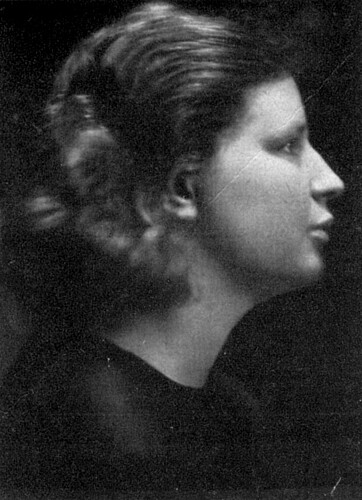
Exactly a quarter of a century ago, on November 26, 2001, Grete von Zieritz passed away at the age of 102. The Austrian composer was—and remains—particularly cherished in Berlin, where she had lived since 1917. In the 1920s, she studied under Franz Schreker at the Hochschule für Musik, now the Music Faculty of the UdK. The “History of the University” column in this newsletter commemorates her on the occasion of this anniversary.
Grete von Zieritz’s long life spanned the entire 20th century. She was born on March 18, 1899, in Vienna and died in Berlin in 2001. The daughter of an officer in the Austro-Hungarian Army—who was ennobled in 1918—her full name was Margarethe Edle von Zieritz; she was awarded the title of professor in Austria in 1958.
When her father was transferred to Graz, the musically gifted girl—having received her first musical impressions in Lemberg (Lviv) while attending school there—began her training at the Conservatory of the Styrian Music Society; it was her “happiest time.” In 1917, she passed her high school graduation exam with honors. Together with her composition teacher, Roderich Mojsisovics von Mojsvár, she traveled to Berlin in the midst of World War I; they had planned to stay for three months, but she ended up remaining there for the rest of her life.
She began by perfecting her piano training under Martin Krause at the Stern Conservatory of Music; Krause was a student of Liszt and a highly respected teacher. After his death in 1918, Rudolf Maria Breithaupt became her teacher and mentor. She worked for a short time as a teacher at the Stern Conservatory but dared to give up this position in order to pursue her ambitions as a composer. Following the success of the *Japanese Songs*, which premiered in 1921 at the Sing-Akademie with the Philharmonic Choir, she decided to become a composer. She pursued this goal tenaciously despite often adverse circumstances: she would never again secure a permanent position for the rest of her life. She earned her living primarily by giving private piano lessons.
As a result of her successful debut, she met—also in 1921—Franz Schreker, the director of the University of Music. The encounter took place at the home of the piano manufacturer Grotrian-Steinweg in Braunschweig; Zieritz was under the patronage of Elsbeth Grotrian-Steinweg and was able to stay there as a guest. At Schreker’s invitation, she joined his class. There were hardly any women composers at that time, but she was not the only one in Schreker’s class: the Hungarian Zdenka von Ticharich, who also distinguished herself as a pianist, as well as Charlotte Schlesinger—a music educator who later emigrated to the United States and England—also studied with Schreker.
Zieritz’s studies were interrupted by her marriage and the birth of a daughter, the future violinist Hedi Gigler-Dongas. Soon, however, Zieritz parted ways with her husband, a writer; they divorced, and their daughter was placed in the care of her grandparents in Austria. By then 27 years old, Zieritz returned to Schreker’s composition class in 1926, where she remained enrolled for another five years.
In 1928, she was awarded the coveted Mendelssohn Prize. Several world premieres of her works took place at the conservatory. It all began with a recital evening organized by the Schreker class; Franz Osborn, who would later become Max Rostal’s duo partner, performed two of her compositions for piano: a Prelude and Fugue in C minor and a suite in four movements. The program also included works by Berthold Goldschmidt, Alfred Freudenheim, Charlotte Schlesinger, and Ignace Strasfogel.
Zieritz now set her sights on breaking into Berlin’s concert halls. Her Four Sacred Songs for baritone, flute, and piano were performed in 1928 at Berlin’s Meistersaal during a concert organized by the International Society for New Music (IGNM); she wrote to Schünemann, the deputy director of the University of Music, in a girlish tone: “Please come on Wednesday! Your grateful Grete Zieritz.”
The largest and most dramatically sweeping work that was staged with the support of her teachers was *Passion im Urwald* (Passion in the Jungle) in 1932—six songs based on her own texts for soprano and orchestra. When the composition was completed in 1930, Schreker apparently considered premiering it at the conservatory. The following year, Zieritz referred to this in a letter to Schünemann, noting that she had even been allowed to present the work to Erich Kleiber, General Music Director of the Staatsoper Unter den Linden. However, after rehearsals had already begun, the performance was canceled; a performance of Schoenberg’s *Gurrelieder* under Schreker’s baton—25 years after its Vienna premiere—took precedence.
Although the concert did take place in the conservatory’s hall, it was not a conservatory event; the premiere of Zieritz’s work was now part of a “Charitable Premiere Concert for Contemporary Composers.” Zieritz was concerned that Schreker might be upset, since he had not been informed of this arrangement from the outset. She stated, however, that he sat contentedly in the conductor’s box alongside Kleiber during the performance.
As music historian Anna-Christine Rhode-Jüchtern has shown, Zieritz was able to rely on a network of women’s associations—some of which held conservative, nationalist views—when establishing herself; influential figures in these circles were sympathetic to the Austrian noblewoman, who was the daughter of an officer. It was organizations such as the German Lyceum Club, the Allied Associations for the Welfare of the Middle Class, and the Circle of Creative Women that provided performance opportunities. As long as the Weimar Republic existed, Zieritz found herself in a dilemma: On the one hand, she was a student of a modern composer who was vilified as “Jewish,” and she wore a bob cut for a time. On the other hand, due in part to her family background, she belonged to more traditionalist circles.
During the “Third Reich,” she achieved some notable successes, not least on the radio. “No doubt,” wrote the *Kreuzzeitung*, an organ of Prussian conservatism, “Grete von Zieritz has a say in contemporary German life.” Her *Vogellieder* (Bird Songs) for coloratura soprano, solo flute, and orchestra were sung by Erna Sack in 1936 at the world premiere in Dresden under the direction of Karl Böhm. Partly because—thanks to her role as a woman—she was musically responsible for the entertaining, community-building, and folksy, but not for the heroic, this did not harm her after 1945; it seemed to have been harmless.
Nevertheless, Zieritz did not have an easy time of it in the postwar period. She was now living in the western part of the city: her apartment was on Marburger Straße, a side street off Tauentzienstraße, not far from the college on Fasanenstraße that had shaped her. She was denied a position there: Paul Höffer, like her a student of Schreker, wanted to hire her as a piano teacher during his brief tenure as director in 1948–49, but then died suddenly; his successor, Werner Egk, left her empty-handed.
Her “Art of Unconditional Expression” exhibited expressionist traits, as Beate Philipp demonstrated in her dissertation accepted by the University of the Arts; as Zieritz reported, her compositional works were often inspired by “images, visions.” She did not disown her teacher, Schreker. Quite the contrary: she was among those who strove to preserve his legacy. With the Schreker renaissance that gradually began around 1980, new opportunities also arose for her.
In 1984, her *Gypsy Concerto* for violin and orchestra was premiered at the Berlin Festival with Marianne Boettcher as soloist. Building on trends of the 1920s, Zieritz remained committed throughout her life to the idea of “music policy,” which she interpreted in her own unique way; among the projects in which she participated was, for example, the exhibition *War Strikes Everyone in the Heart*, which was shown in Minsk and Berlin in 1984–85 and in which the University of the Arts was involved as an organizer. She had now become a fixture in Berlin’s contemporary music scene.
Researchers can be grateful that Zieritz took it upon herself to preserve her documents: in 1934, she met archivist Toska Lettow, who established a personal archive for her. It was transferred to the Austrian National Library as a so-called “pre-bequest,” that is, during her lifetime.
Author: Dr. Dietmar Schenk (former director of the University Archives)
Note:
On May 26, 2026, the Styrian State Archives in Graz held a conference titled “The Archive as a Mirror of the Times” to mark the acquisition of the estate of violinist Hedi Gigler-Dongas. As mentioned, she is the daughter of Grete von Zieritz. Zieritz’s life and work were also a recurring topic of discussion. The presentations will be published in the State Archives’ yearbook in 2027.