Sergiu Celibidache
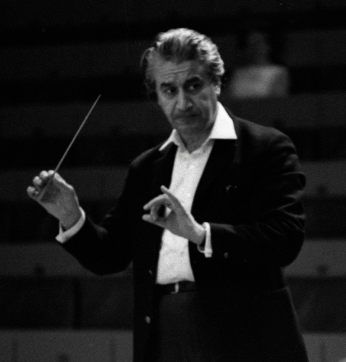
Sergiu Celibidache died 30 years ago, on August 14, 1996. Having come to Berlin from Romania, he studied choral conducting and composition at the Hochschule für Musik—now the Music Faculty of the UdK—in the midst of World War II. After the war ended, he became Furtwängler’s “deputy” as principal conductor of the Berlin Philharmonic. It is little known that Celibidache had previously studied under Furtwängler at the conservatory.
There were many half-truths circulating about Sergiu Celibidache’s life. However, what he stated in his résumé when applying to the Academy of Music is likely accurate: He was born in Roman, a city in the Moldavia region of Romania, on June 28, 1912, according to the Julian calendar, as the son of an officer. He later studied mathematics for a time in Bucharest but had to abandon his studies for financial reasons. Returning to Iaşi, where he had grown up, he taught himself to play the piano and study music theory. He earned a living as a piano accompanist at a dance school and, drawing on the experience he gained there, went on to found a dance school of his own.
In early 1939, Celibidache arrived in Berlin. At the University of Music, he applied to audit classes taught by Kurt Thomas, a composer and choir director who was highly regarded at the time. Celibidache wanted to use this opportunity to prepare for the entrance exam. He listed his address as 26a Eisenzahnstraße in Halensee. The request was denied, but he passed the exam nonetheless and began his studies in the summer semester in the field of musical composition; as he had requested, Heinz Tiessen was his teacher. His father paid the tuition fees, as is specifically noted in the student file.
On September 1, 1939, the German invasion of Poland marked the beginning of the horrific war we now call World War II. At that time, Celibidache’s homeland was drawing closer to the Axis powers—namely, the National Socialist German Reich and Fascist Italy. The Berlin conservatory, in which he enrolled, had—on the surface—consolidated itself following the exodus of faculty in 1933; the favorable economic conditions during the early years of the Nazi regime contributed to this. It now confidently assumed its position as the capital’s music conservatory in the “Greater German Reich.” Its director, Fritz Stein, a musicologist, was admitted to the NSDAP in 1940.
Celibidache already had connections when he arrived in Berlin. He frequented the upper-class home of the economist and sociologist Werner Sombart in Grunewald, whose wife was Romanian. Their son Nicolaus, for whom Celibidache served as a “spiritual mentor” for some time, described the young musician’s unusual appearance in his memoir *Youth in Berlin*. “Cili” (or “Celi”), as he was called, had wide-ranging interests: He was fascinated by all sorts of philosophical questions and was introduced to Zen Buddhism in Berlin. As evidenced by his eccentric clothing, he had a penchant for self-expression.
Heinz Tiessen quickly came to appreciate the ambitious young man, and Celibidache, in turn, held his teacher in high regard. Before 1933, he had been closely associated with the workers’ education movement. His professional career began in Berlin within Richard Strauss’s circle. For a time, he served as a conductor at the Volksbühne. He was also part of the circle of musicians and writers associated with the journal *Melos* and was active in the International Society for Contemporary Music. In 1926, he was appointed to the University of Music as a professor of composition and music theory.
During the Nazi era, he managed to turn his life around and lead an existence that was—apparently—largely left undisturbed. He was able to keep his position at the university; his student Eduard Erdmann joined the party, which Tiessen apparently avoided doing. In the postwar period, he exchanged long letters with Leo Kestenberg, the former music advisor at the Prussian Ministry of Culture, who had been forced to emigrate. They had been companions in their younger days; the effusively friendly tone—on both sides, incidentally—seems a bit contrived from today’s perspective.
But back to Celibidache. As his studies progressed, it became clear that he was particularly gifted in the field of conducting. Before the start of the 1940–41 winter semester, he took a second entrance exam, this time in that subject. He passed the exam again and was admitted to the class of Theodor Jakobi, who had been teaching at the conservatory since 1932; from 1940 onward, Jakobi led the a cappella choir. As a now-advanced student, Celibidache gradually took on increasingly significant practical responsibilities: He occasionally stood in for his teacher Tiessen as conductor of a mixed choir, organized chamber concerts with a student ensemble, and eventually conducted orchestral concerts in “neutral foreign countries,” which were made possible with the support of the Foreign Office.
Celibidache’s charm and charisma made an astonishingly strong impression on his teachers. Whether it was because they wanted to help prevent his conscription into military service in Romania, or because the irrationalism of an exaggerated notion of genius prevailed—the Prussian rigor that had characterized evaluations at the university for decades was completely lost; an almost fawning tone emerged.
Tiessen wrote that Celibidache was “well on his way” to “becoming a leading musical figure of the very highest order.” He arrived at this “rare assessment” by applying the strictest standards. Other instructors also lavished praise on him. Walther Gmeindl, director of a conducting class, wrote: Celibidache was “a highly promising musical talent and—I have no hesitation in saying—a man who will most certainly one day influence the musical life of his native Romania.”
After a five-year course of study—which was long by the standards of the time—Celibidache passed his final exams in 1944. This occurred at a time when Romania had switched sides in the war raging across Europe; he was now a citizen of an enemy country. In this situation, Fritz Stein, the director of the University of Music, also spoke up on his behalf. Having earned the grade “With Distinction” in all individual subjects, Celibidache had achieved “an exam result” that “had not been seen in many years,” Stein wrote to the dean of the Faculty of Philosophy at the University of Berlin. He requested that Celibidache be admitted to the doctoral examination there despite his status as a “foreigner.”
Part of the University of Music’s efforts to uphold standards despite Nazi influence was its attempt to recruit Wilhelm Furtwängler. In 1941, Stein was able to persuade the famous conductor to accept a teaching position. As agreed, this involved allowing a handful of students to attend rehearsals of the Berlin Philharmonic. The visits were followed by a discussion during which the famous conductor answered questions. One of the participants was Sergiu Celibidache.
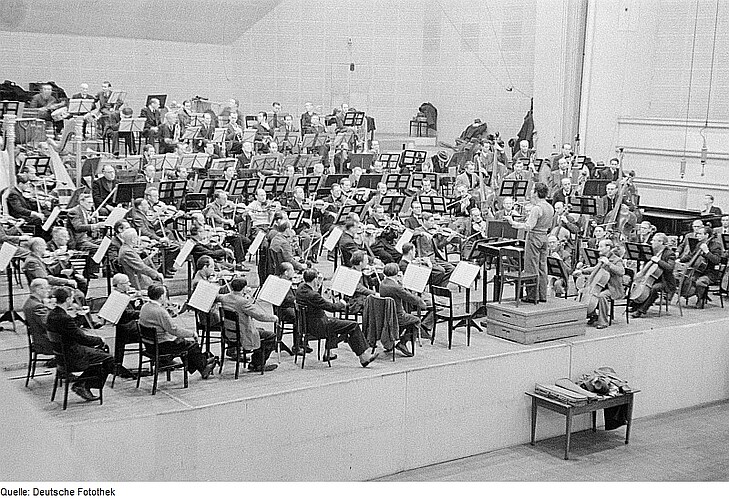
The encounter with Furtwängler at the conservatory was part of the prelude to the “great philharmonic conflict” (Klaus Lang), in which the two conductors became rivals in the immediate postwar period. The Berlin Philharmonic Orchestra found itself in a difficult situation at the end of 1945. Its traditional concert hall on Bernburger Straße had been destroyed. Leo Borchard, who had led the orchestra in the first weeks after the end of the war, was shot and killed by mistake by an American soldier in August 1945. And Wilhelm Furtwängler, the long-time chief conductor, was barred from performing until his denazification proceedings were concluded. The 33-year-old Celibidache, who had been a student just a short time before, stepped in. As is well known, however, the young conductor was unable to establish himself in Berlin in the long run.
Incidentally, he remained loyal to his teacher, Tiessen. In December 1946, he included Tiessen’s prelude to a revolutionary drama in a program by the Berlin Philharmonic, and on Tiessen’s 70th birthday in 1957, he conducted the Radio Symphony Orchestra in the closing concert of the Berlin Festival with a “Tiessen program” that, at the honoree’s request, concluded with Beethoven’s Symphony No. 7. On that October 7, the program featured the Hamlet Suite, Two Orchestral Pieces based on the dance drama *Salambo*, and Symphony No. 2, “Die and Be Reborn!” Tiessen noted that Celibidache “conducted all the works from memory.”
Author: Dr Dietmar Schenk (former Head of the University Archives)