Paul Hindemith
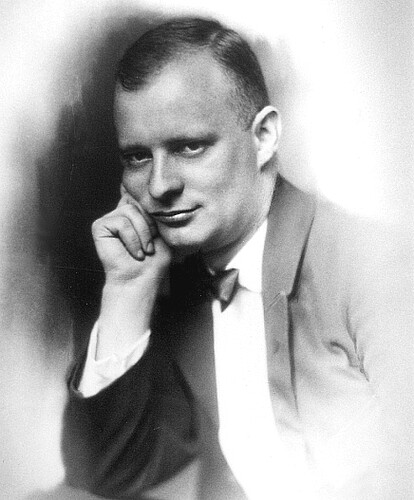
The provocative performance instructions that the young Paul Hindemith wrote down in 1922 read like an incitement to dissent: “Wild. The beauty of the sound is secondary” (Op. 25 No. 1) or “Pay no heed to what you learnt in your piano lessons” (Op. 26). No wonder he earned a reputation as a public nuisance. Yet in 1927 he took up a post as a teacher at the Berlin University of the Arts, through which he became a representative of a new, yet now established, generation. In keeping with this year’s Crescendo theme, ‘GegenTöne’, the column on the history of the university is dedicated to this composer.
Before and after the 1914–1918 war, Paul Hindemith (1895–1963) established himself in the bourgeois musical life of his hometown, Frankfurt am Main, as a violist and through his early compositions. One detail foreshadows the years that interest us here: Hindemith’s composition teacher at the Hoch Conservatory was Arnold Mendelssohn, who had studied at the Berlin Institute for Church Music and at the University of Music.
The initial impetus for Hindemith to move to Berlin in the mid-1920s likely came from Georg Schünemann, the deputy director of the university. He worked closely with Kestenberg, the music advisor at the Prussian Ministry of Culture; however, in a letter written in 1926 following a meeting with Hindemith at the Donaueschingen Chamber Music Festival, Kestenberg noted that Hindemith could probably not be counted on. He was “full of contempt for university life and interested only in town pipers and the like”.
Yet shortly afterwards, Hindemith accepted a post at the Berlin Academy. He began teaching in the summer term of 1927; his arrival had already been heralded by a musical debut in February. He performed with a trio in the Academy hall; the programme featured “chamber music on period instruments”, ranging from Handel to Stamitz. Hindemith played the viola d’amore, together with Alice Ehlers on the harpsichord – a Hungarian student of Wanda Landowska during her time at the Academy – and with his brother Rudolf Hindemith (viola da gamba).
By accepting the post in Berlin, Hindemith chose the capital of the Reich, which by then had come to hold a certain prominence over all other German cities of music. In parallel with this change of location, Heinrich Strobel wrote a separate volume in the ‘Melosbücherei’ about the musician, who was then only 32 years old, and noted: ‘The highest state offices are being entrusted to a composer who, five years ago, could still have been described as the “enfant terrible” of German modernism.’ Furthermore, Hindemith expanded his field of activity. Until then, he had composed extensively and given numerous concerts, but had not taught. From pedagogy, he soon made inroads into the field of music theory; a legacy of his Berlin years is his three-volume work *Unterweisung im Tonsatz* (*Instruction in Composition*), the first volume of which appeared in 1937, the year of his dismissal from the Academy.
In Berlin and at the Academy, Hindemith immediately threw himself into a wide range of activities. The experimental radio station, which opened in the spring of 1928, had long been planned by the time he arrived; yet he played an advisory role in the development of the Trautonium, an electric musical instrument invented there. He sent one of his students, Oskar Sala, to the attic of the teaching building on Fasanenstraße – to join the tinkerers who were experimenting there with electrically generated sounds. Sala was one of the first to play the instrument; he remained loyal to it throughout his life and continued to develop it.
This event organised by the Radio Experimental Station continued the Donaueschingen and Baden-Baden Music Festivals, which, as is well known, were significant for the development of New Music in the 1920s; Hindemith sat on the programme committee. He now contributed music produced by Grammophon (musique concrète), and the children’s Singspiel *Wir bauen eine Stadt* received its world premiere. In the courses on radio speech and radio music affiliated with the Experimental Station, Hindemith taught the sound film course.
Important personal connections are also linked to the Academy. During his years in Berlin, Hindemith formed a trio with Emanuel Feuermann (cello) and Josef Wolfsthal (violin); both were colleagues at the Academy. Hindemith also met Fritz Jöde, a leading figure in the youth music movement, who worked at the neighbouring Academy of Church and School Music. Even the rift with Bert Brecht can be traced back to the Academy, as its modernisation during the Weimar Republic was a ‘reformist’ project, whilst Brecht turned towards communism.
Alois Hába – a composer from what was then Czechoslovakia, who had himself studied at the conservatoire just a few years earlier – described Hindemith as a teacher who still seemed very youthful. The manner of a professor was alien to him: “he could astonish all adherents of ‘distant authority’”. Hindemith embraced the zeitgeist of New Objectivity. His charisma as a teacher was considerable: some in Schreker’s circle, such as Charlotte Schlesinger and Kurt Fiebig, felt drawn to Hindemith. When, in 1934, already during the ‘Third Reich’, he was approached by the National Socialist propaganda minister Joseph Goebbels, numerous students immediately showed solidarity with him, foremost among them Hans-Joachim Koellreutter – who later emigrated to Brazil.
If Hindemith’s class did not produce quite such big names as those found among Schreker, Schönberg and Busoni, this is likely due to the circumstances of the time. Anyone studying around 1930 was bound to face difficulties in life and in their career. Hindemith’s London-born pupil Walter Leigh died in the Second World War as a soldier fighting on the Allied side; Hans Ulf Scharlau fought on the German side and is missing in action. Also worth mentioning are Franz Reizenstein, who emigrated to England; Remi Gassmann and Bernhard Heiden, who went to the USA; and Harald Genzmer, who taught composition in Freiburg and Munich after 1945.
Hindemith’s years in Berlin were marked by profound cultural upheavals, which he actively participated in. Among these was the emergence, as early as 1930, of a more conservative mood that replaced the modernism of the 1920s. Hindemith responded to this changed atmosphere with the oratorio *Das Unaufhörliche* (1931), which he created in collaboration with Gottfried Benn. The ‘comic opera’ Neues vom Tage, premiered just two years earlier with a libretto by Marcellus Schiffer, an author of literary revues, is quite different: here a cool satire, there a certain gravity with restrained pathos.
On 30 January 1933, Adolf Hitler was appointed Reich Chancellor. Despite the rigorous purge of the Academy of Music, Hindemith retained his position and adapted to the new situation. The ousted director Schünemann was now head of the instrument collection; together with him, he organised ‘music lessons’ featuring early music played on historical instruments. He exchanged ideas with the music theorist Herman Roth, a pupil of Heinrich Schenker. Nevertheless, the situation became precarious for Hindemith too: in the personnel file, which is kept in the archives of the University of the Arts, there is a reference to a – now lost – ‘secret file’ concerning his wife Gertrud, née Rottenberg, the daughter of the Jewish Kapellmeister at the Frankfurt Opera.
Hindemith was initially prepared to remain in Germany. However, he was unwilling to accept his ostracism from public concert life by the Nazi regime. The world premiere of the Mathis Symphony with the Berlin Philharmonic under Wilhelm Furtwängler in 1934 turned into a demonstration in his favour. Furtwängler subsequently advocated for Hindemith’s rehabilitation in a newspaper article. Goebbels, however, reacted with harsh rejection. In a speech at the Berlin Sportpalast, he responded to Furtwängler’s intervention and described Hindemith as an “atonal noise-maker” whom Germany could do without.
Hindemith subsequently applied for a leave of absence from the conservatoire. He went to Turkey for a time, where he acted as an advisor on the development of the music scene. The National Socialist director, Fritz Stein, attempted to mediate. Hindemith returned to the conservatoire once more, but handed in his resignation in 1937. In 1938, on his way to the USA, he went to Switzerland. From Sierre in Valais, Rilke’s former refuge, Hindemith wrote in December 1930 to Wolfgang Boettcher, the director of the folk music school in the working-class district of Neukölln, where he had taught on a voluntary basis: “Berlin is further away than the North Pole, and the time spent there has vanished without my ever having thought of it with the slightest pang of longing.”
The ‘Hindemith affair’ in 1934 had caused quite a stir in Berlin and remained fresh in people’s minds. When the conservatoire reopened after the war, in the autumn of 1945, the Mayor of Berlin publicly asked Hindemith to take over as director. No formal request was apparently made to him – he was teaching at Yale at the time – but the university’s senate approached the composer twice, in 1946 and 1948, to sound him out. Hindemith, however, did not wish to return to Germany; he moved to Switzerland in 1953.
Hindemith did, however, appear as a conductor on several occasions in the new concert hall on Hardenbergstraße. The hall, designed by Paul Baumgarten, was popularly nicknamed ‘Bahnhof Hindemith’ in Berlin – in the post-war period, Hindemith was regarded in wide circles, particularly in Berlin, as the leading exponent of musical modernism. Today, the Association for the Promotion of Music and Drama at the University of the Arts bears the name Paul Hindemith Society in Berlin.
Author: Dr Dietmar Schenk (former Head of the University Archives)