Wolfgang Boettcher
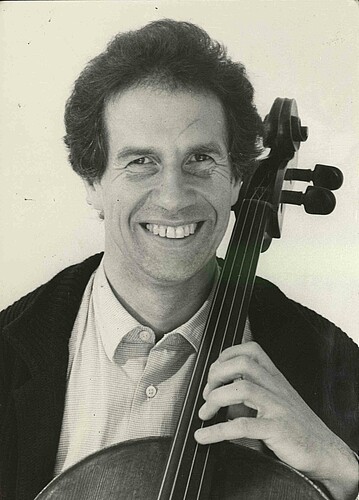
Wolfgang Boettcher
Five years ago, on 24 February 2021, the cellist Wolfgang Boettcher, a veteran of the UdK, passed away at the age of 86. The university history column takes this date as an opportunity to pay tribute to the renowned soloist, chamber musician and teacher with a profile. Boettcher was a Berliner; he studied at the Hochschule für Musik, now the Faculty of Music at the UdK, and in 1976 moved from the Berlin Philharmonic to what was then the University of the Arts, to which he remained loyal – despite receiving many other offers. The number of his distinguished pupils is vast.
Wolfgang Boettcher, born on 30 January 1935, grew up in a home “filled with beautiful music”, as he recounted in a radio interview as recently as 2020. His parents were very musical: his father Hans ran the folk music school in Neukölln, an innovative centre for ‘public education’ where Paul Hindemith also taught during the Weimar Republic. Hans Boettcher was an academic and a pioneer of music sociology, not least as co-editor of the short-lived but conceptually interesting journal Musik und Gesellschaft (1930/31), which he had founded together with Fritz Jöde.
His mother, Hildegard, was from Transylvania and came to Berlin from Sibiu to study music. In 1932, she married Hans Boettcher, and the couple moved to Kleinmachnow. Wolfgang had two sisters: an older one, Ursula Trede-Boettcher, and a younger one, Marianne Boettcher; both of them also became respected musicians. They tragically lost their father in 1945, in the days following the Red Army’s occupation of Berlin. This only served to bring the rest of the family closer together: the three siblings temporarily formed the Boettcher Trio.
Wolfgang Boettcher studied the cello at the Berlin University of the Arts; his teacher, whom he held in high esteem throughout his life, was – initially as a private tutor – Richard Klemm. The vast world of music opened up to him partly thanks to family connections: his godfather, Eberhard Preußner, invited him to the summer academies at the Mozarteum in Salzburg. There, Boettcher was able to get to know many prominent musicians who were regular visitors to the Preußners’ home from a young age. In 1958, Boettcher won second prize at the ARD International Music Competition in Munich. In the same year, he took up a position with the Berlin Philharmonic. It was the era of Herbert von Karajan; under his aegis, Boettcher became second principal cellist.
The decision to move to a professorship at the University of Music in Charlottenburg’s Fasanenstraße in 1976 was not an easy one for Boettcher. Yet he proved to be a gifted teacher, a fact to which his cheerful yet approachable nature contributed. An almost incalculable number of cellists emerged from his school; the commemorative book Jawoll, edited by Claus-Ulrich Bader – whose title incorporates Boettcher’s Berlin dialect – brings together texts and testimonials from more than 150 companions, colleagues and friends, including many former students.
Boettcher war Cellist im Brandis-Quartett, das er mitbegründete; der Primarius, Thomas Brandis, hatte an der Hochschule eine Professur für Violine inne. Boettcher gehörte auch zur Urbesetzung der 12 Cellisten der Berliner Philharmoniker. Als Solist konzertierte er unablässig und weltweit. In Japan hatte er die Ehre, mit Kaiserin Michiko zu spielen. Boettcher engagierte sich für den Grand Prix Emanuel Feuermann, den die Kronberg Academy zusammen mit der Universität der Künste durchführt; Feuermann, ein Cellist, den Boettcher bewunderte, war in der Weimarer Republik Lehrer an der Berliner Hochschule. Als Leiter der Sommerlichen Musiktage Hitzacker zwischen 1987 und 1993 öffnete Boettcher das kammermusikalische Repertoire des Festivals für die Gegenwart, für das musikalische Schaffen NS-verfolgter und jüdischer Komponisten sowie für Alte Musik. Gemeinsam mit Winfried Pape legte Boettcher die Monographie Das Violoncello (1996, 2. Aufl. 2005) vor. Boettcher konzertierte bis an sein Lebensende und spielte zahlreiche CDs ein.
Through his father, Wolfgang Boettcher carried on the vibrant tradition of a commitment to both music education and social engagement, a tradition associated with the name of Leo Kestenberg, the legendary music advisor at the Prussian Ministry of Culture. This work, incidentally, continues within the Boettcher family: Marie Kogge, Wolfgang Boettcher’s daughter, is dedicated to the MitMachMusik initiative. Its aim is to use music to pave the way for the integration of refugee children and young people.
Several obituaries for Wolfgang Boettcher are still available online; there you will find further details about his life and work. There is no need to repeat them here. Instead, I would like to mention a personal encounter that brought me together with Boettcher when it came to questions of archiving. I visited the cellist’s flat several times, with a gap of more than two decades between visits.
In 1998, the focus was on the estate of Eberhard Preußner – whom I have just mentioned. In Berlin, as a musicologist and writer, he had been something of Kestenberg’s right-hand man in the musical reforms of the Weimar Republic; later he moved to the Mozarteum in Salzburg. Wolfgang Boettcher’s wife, Regine (Gini) Boettcher, a niece of Preußner, kept his manuscripts, notes and letters, which she, to my delight, donated to the archives of the Berlin University of the Arts. Previously, Wolfgang Boettcher had already made available to us a letter from Hindemith to his father for publication. It had been written in 1939, shortly before his emigration to the USA, in Sierre (Canton of Valais, Switzerland): as a kind of farewell letter.
Some time later, I was entrusted with the task of taking charge of Boettcher’s own estate. From the perspective of my work as a historian, I had been following his work all those years. Shortly before his death, he asked me for information about details of the Nazi era. In 2022, I was invited back to the flat near the Wannsee S-Bahn station to help organise the estate and to advise on what should be sent to the archive. Together with Marie Kogge, I climbed a ladder to the attic where Boettcher had once worked. There I saw the ‘Studio’, the ‘Study’ and the ‘Library’ – these were the labels on the boxes in which we received the archive material. After friends of the family had helped to sort through the sheet music, documents and audio recordings, everything was taken to the University of the Arts’ archive by the firm Stadtbote in the autumn. The grandchildren helped to load the van that carried out the transport. After transferring the items to archive-suitable materials, we counted the archive boxes; there were no fewer than 117.
In September 2023, during an internship with us, an archivist trainee, Lasse Stodollick, drew up an initial rough inventory of the estate. He summarises the contents as follows: “The estate […] comprises labelled sheet music, comprehensive performance documentation including programmes and press reports, numerous sound recordings, and handwritten scores, including works by contemporary composers who sent their works to Boettcher for review, for performances, or as a signed copy. […] From his decades of teaching, there are lesson preparations, minutes and documents relating to salary and contract negotiations. Boettcher made comments on students and competition entrants on scraps of paper, in notebooks or on the back of programme booklets. […] Hans Vogt, Karlheinz Stockhausen, György Ligeti, Yoko Nakamura and Aribert Reimann maintained a sometimes lively correspondence with Wolfgang Boettcher.”
All of this is extremely fascinating and deserves a detailed analysis, which will certainly take place soon.
Author: Dr Dietmar Schenk (former Head of the University Archives)