In-Between Spaces - 2025
In-between Spaces - 6. Semester
Space is the area between and around objects. The space around ojects is often called negative space; negative space has shape. Space can also refer to the feeling of depth. Real space is three-dimensional; in visual art, when we create the feeling or illusion of depth, we call it space.
The J. Paul Getty Museum
Witnessing the subtle moment between body and textile, l’espace entre le corps et le vêtement. Putting the focus on the in-between spaces, using this undefined moment as a starting point to the semester project.
The diversification of the in-between space through movement due to external and internal influences gives the idea of hybrid spaces. Prioritizing the interior space, passages, places of the empty invisible and undefined emptiness. A form of intimacy, connecting clothing and body suggesting distance and point of contact at the same time.
What does the space between body and garment provoke?
The irregularity of in-between spaces and their 3-dimensionality referring to a feeling of depth, claiming space and the illusion of space at the same time. Spatial zones, optical and conceptual fuzziness, the intermediate as the basis for creation.
Marie Rost
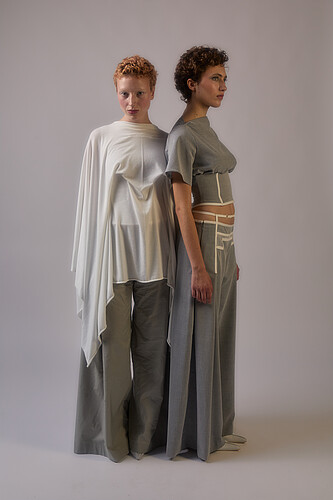
This project explores the feminist theory of the fragmented female body—how society views women not as a whole, but as isolated parts to be judged and modified. Each look in this collection emphasizes a different body part, highlighting this cultural dissection through silhouette and volume. I was inspired by white needlework techniques, both in material and concept, reworking their associations with femininity. The result is a reflection on control and beauty.
Fotografin: Ada Retegan @adaretegan
HUMA: Jasmin Oliveira Oppitz @jasplz
Models: Elsa del Corte @elsaminja, Allegra Casini @babyfishfrog, Mila Akosua Bergner @mili.ta_morenita
Rosalie Bock
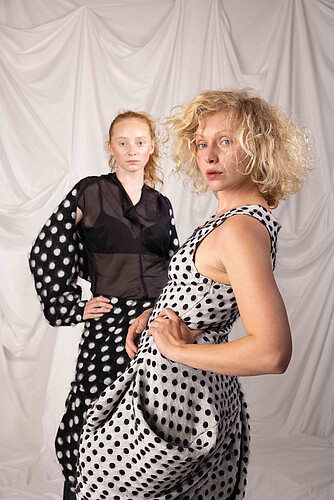
Die Kollektion „inbetween dots“ erforscht die Oberfläche, die den Raum zwischen Körper und Kleidung definiert. Die Silhouette eines Körpers wird durch Kleidung immer verändert. Wie beim Blick durch ein Guckloch, wird die Wahrnehmung des Körpers verzerrt, Konturen verschwimmen. Dieser Eindruck wird durch grafische Effekte auf die stoffliche Oberfläche übertragen.
Traditionelle handgewebte Stoffe sollen ihren Raum im modischen Kontext finden und ihr Potenzial entfalten. Durch Drapage und Schnittechnik wird ein sensibler Umgang mit dem Material gefunden. Dabei wird der Wert des Stoffes durch minimalen Verschnitt aufrecht erhalten.
Fotografie: Oemer Akdag
Models: Sophie Brattinga, Lea Brattinga, Selin Özcan, Sonia Sabot (Fittings)
Kilian Falb
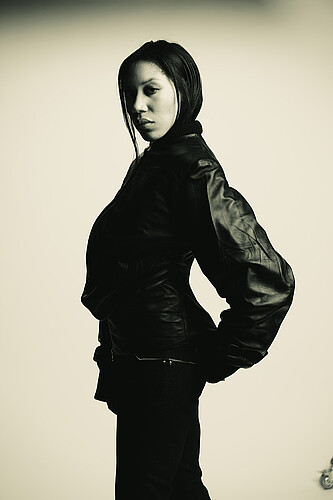
Shaped by the 2014/15 Tumblr aesthetic, emocore, and metalcore, this collection revisits that time through a grown-up, reflective lens. Back then: dark lyrics, screams and melody, the interplay of aggression and vulnerability. A scene where pain became a stylistic tool, marked by black hair, eyeliner, skinny jeans, and band tees. Raw, overloaded, impulsive. Everything styled.
Children of Divorce is a contemporary interpretation of that identity phase. Key elements like skinny jeans, bomber jackets, leather, deep necklines, and fitted shirts are translated into a reduced, refined form for womenswear. The color palette remains stark: black and white. Logos and distressing disappear, giving way to cleaner silhouettes and subtle, material-focused expression.
This collection moves away from the unpolished emotionality of the era’s fashion without denying its roots. It translates personal memory into garments with distance, maturity, and clarity.
Styling: Belanna Dittrich @belannadittrich
Photos: Pius Neuhauser @piuszudemneuhauser
H&M: Alexander Lichmann @alexanderlichmann
Models: Belanna Dittrich @belannadittrich, Jade Juniper @jadedjuniper
Sami Garrafa Schmalz
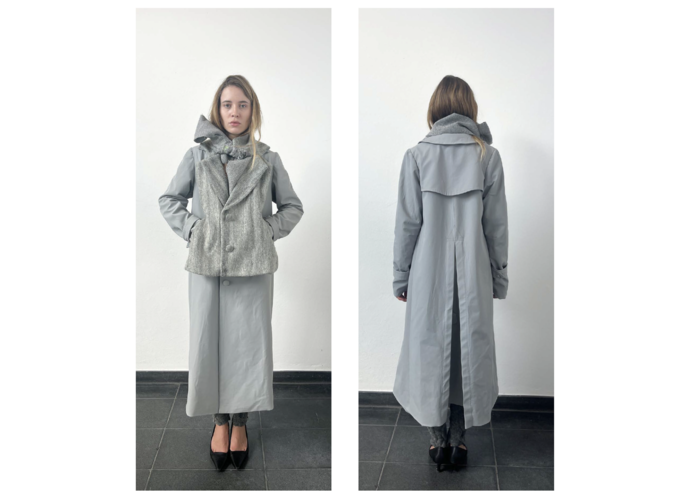
„within and without“
Between protection and disclosure -
Silhouettes emerge that turn the
inside out and merge the
familiar into an existential crisis.
Fotos: Sami Garrafa Schmalz
Design: Sami Garrafa Schmalz
Model: Carlotta Garrione @carlottagarrione
Boye Im
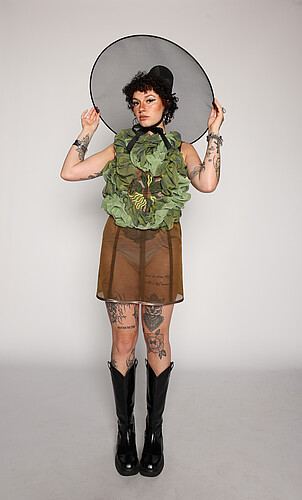
Das Thema unseres Semesterprojekts ist Between Space – vor allem der Raum zwischen Körper und Kleidung.
Als ich über dieses Konzept nachgedacht habe, musste ich sofort an Mandu denken.
*Mandu ist koreanische Teigtaschen- wie Dumpling
Mandu besteht aus einem flachen Teig, der eine Füllung umschließt und dadurch Volumen entsteht.
Zwischen der Füllung und dem Teig bildet sich ein unregelmäßiger, dreidimensionaler Raum.
Beim Dämpfen wird der Teig halbtransparent, und man kann die Füllung leicht sehen – innen und außen vermischen sich optisch.
Für mich passt das gut zum Thema: Der Raum zwischen Körper und Kleidung ist auch oft unsichtbar, aber fühlbar
Mandu isst man in Korea zu Seollal, dem koreanischen Neujahr.
Deshalb wollte ich auch Elemente der traditionellen Kleidung, dem Hanbok, in meine Designs einbringen.
In meinen Entwürfen habe ich durchscheinende, traditionelle Stoffe verwendet, die an den Teig von Mandu erinnern. Elemente aus der Silhouette und Struktur des Hanbok habe ich ebenfalls eingebracht.
Styling: Bohye Im
Photos: Bohye Im
Models: Yuexi Wu, Carmelina, Carline, Miriam, Anette, Celina
Lilith Kunst
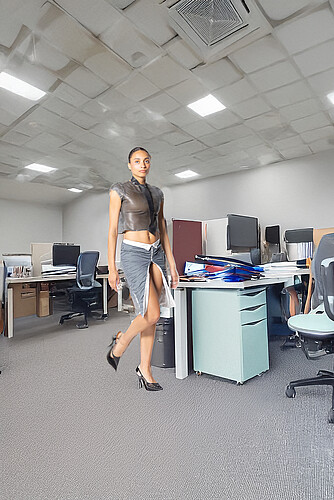
My semester project explores the the subtle, often overlooked space between body and textile — and reinterprets it as a site of feminist resistance.
I see the "in-between" not only as a physical or aesthetic concept, but also as a metaphor: a space women have historically occupied in patriarchal structures — present, but often invisible, constrained, or rendered secondary. Inspired by Invisible Women by Caroline Criado Perez, which exposes how data bias marginalizes women in public, economic, and professional life, I want to use fashion to visibilize this overlooked presence and the labor of navigating systems never designed for us.
My concept centers on office wear, traditionally associated with authority, conformity, and masculinity. I subvert this by working with materials culturally coded as feminine — lace, knitwear, and other "soft" textiles — to challenge power norms and gender-coded dress codes. These fabrics, historically tied to domesticity or delicacy, will instead take up space and are made visible. This evokes the complexities of womanhood in professional environments: the need to be present but not too assertive, visible but not threatening — the constant balancing act between conformity and subversion.
Ultimately, my goal is to design garments that don’t just clothe the body, but reveal the politics of space around it. I want each piece to act as a quiet form of protest — intimate, conceptual, and deeply personal — giving form to the invisible negotiations women face daily, and celebrating the potential of that in-between to become a space of power.
Design: Lilith Kunst
Photography: Melina Eisinger
Talent: Crystal Gon
Benedikt Scheib
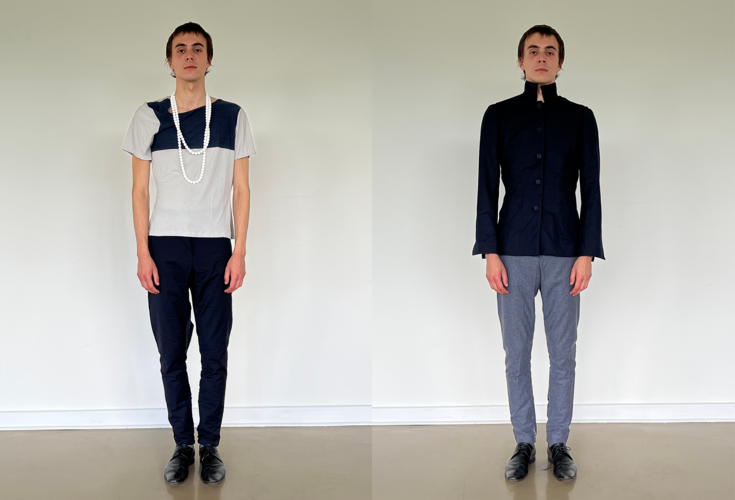
It was the first time I was home alone.
I was fourteen.
I found myself back in my parents’ wardrobe, when I was fourteen. I remember the first time I played around with my mum’s blazers and cardigans, her necklaces, and my dad’s jackets and
Photos und Model: Benedikt Scheib
Malene Specht
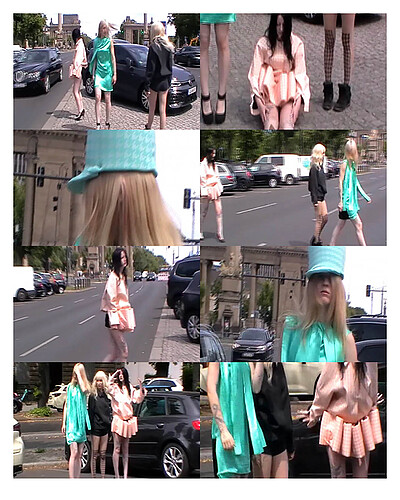
Photograph: Oliver Leone
Model: Delphine Wigger, Erik, Carlie Rodiriguez, Sarah
Make Up: Hugo Trixx, Anna
Production: Malene Specht
Location: Malene Specht
Art Direction: Malene & Oliver :))))))))
Sophie Brattinga
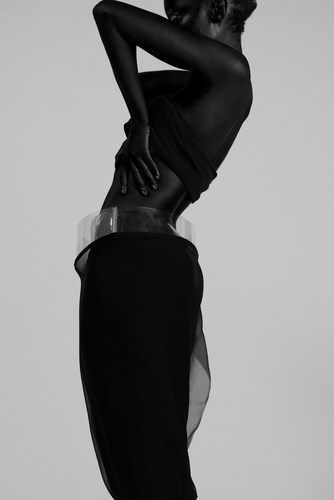
A study of movement shade, captured by slow exposure photography, led to a system of radial body sculptures which can captivate an otherwise fleeting moment in to the analog world.
As knows in clothing, the carier of the garment is the body of the wearer. However, to enclothe a moment, where the body no longer is but supposedly was, the body of the wearer needs expanding. To do so, The bodys of the models have been replicated by plaster casting, which in return are deep-drawn using a translucent PET material. This exact plastic cast of the body was used to hold a radial shape that overpassed all the body´s curves in distance. Therefore making it possible to throw straight lines next to the body as we know them from shadows and slow exposure photographs. The sillhouetes are simple by choice, as to reference the simplicity of light and shade, casting an outline.
The collection consists of three looks, that each consist of two layers. The inner garment, made from viscose crepe and bias cut, hugs the body. The outer layer plays the role of the movement shadow which is translated with the help of silk chiffon.
As the shade holding system was developed to be entered simply by openening the right side, the following textile openings are magnetic and feature self-closing seams.
Models: Cecilia Susant, Johanna Quester, Lea Brattinga
Photographer: Tim Keuschnig
Intern: Jing Ling
Xander Tuor
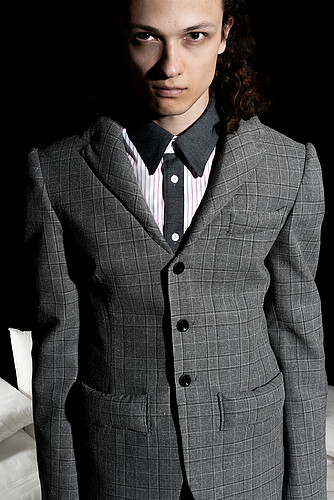
Gradlinige Schnitte treffen auf subtile Ironie und spielerische Details, die gängige Vorstellungen von klassischer Männermode herausfordern. In ihrer aktuellen Kollektion, entstanden im Rahmen des Modedesign-Studiums an der UdK Berlin, rekonstruiert die Designerin Elemente wie Kragen, Revers, Manschetten und Taschen neu – in präzise kartierten Partien. So entsteht eine frische, unkonventionelle Interpretation des Anzugs, die formale Strenge mit Leichtigkeit und Humor durchbricht. Die Kollektion erö ffnet eine zeitgemäße Perspektive auf Tailoring und verleiht dem klassischen Herrenanzug eine junge, eigenwillige Stimme.
Model: Janek/ @janek_sdt
Fotograf: Konrad Wieberger (kein instagram)
Lina Nix
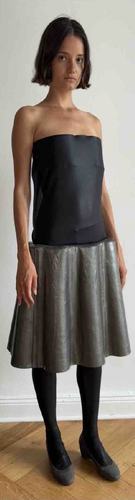
Die sechsteilige Look-Serie beschäftigt sich mit der visuellen Sprache der 1950er Jahre – einer Dekade, die modisch stark von klar definierten Silhouetten, normierten Schönheitsidealen und einer betonten Feminität geprägt war. Die ikonischen Formen dieser Zeit – etwa die Sanduhr-Silhouette mit schmaler Taille, betonten Hüften und breiten Röcken – stehen nicht nur für ein ästhetisches Ideal, sondern auch für gesellschaftliche Kontrolle, Nachkriegsordnung und eine Rückkehr zu „weiblichen“ Rollenbildern. Dieses Projekt greift jene Formensprache auf, verschiebt jedoch Volumen und Schwerpunkte bewusst an andere Stellen des Körpers – weg von Taille und Hüfte, hin zu neuen, ungewohnten Zonen. Durch das Versetzen von Volumen oder das Zerschneiden klassischer Proportionen entstehen Silhouetten, die vertraut und fremd zugleich wirken. Der Körper wird dadurch nicht mehr idealisiert, sondern neu interpretiert und irritierend inszeniert.
Lehrende
Gastprof. Jutta Klingel
KM Teresa Fagbohoun
LB Anna Ervamaa (Textil und Farbe)
Dorothée Warning (Fertigung)
Stefan Hipp (Schnittkonstruktion)
Julia Kunz (Färberei & Siebdruck)